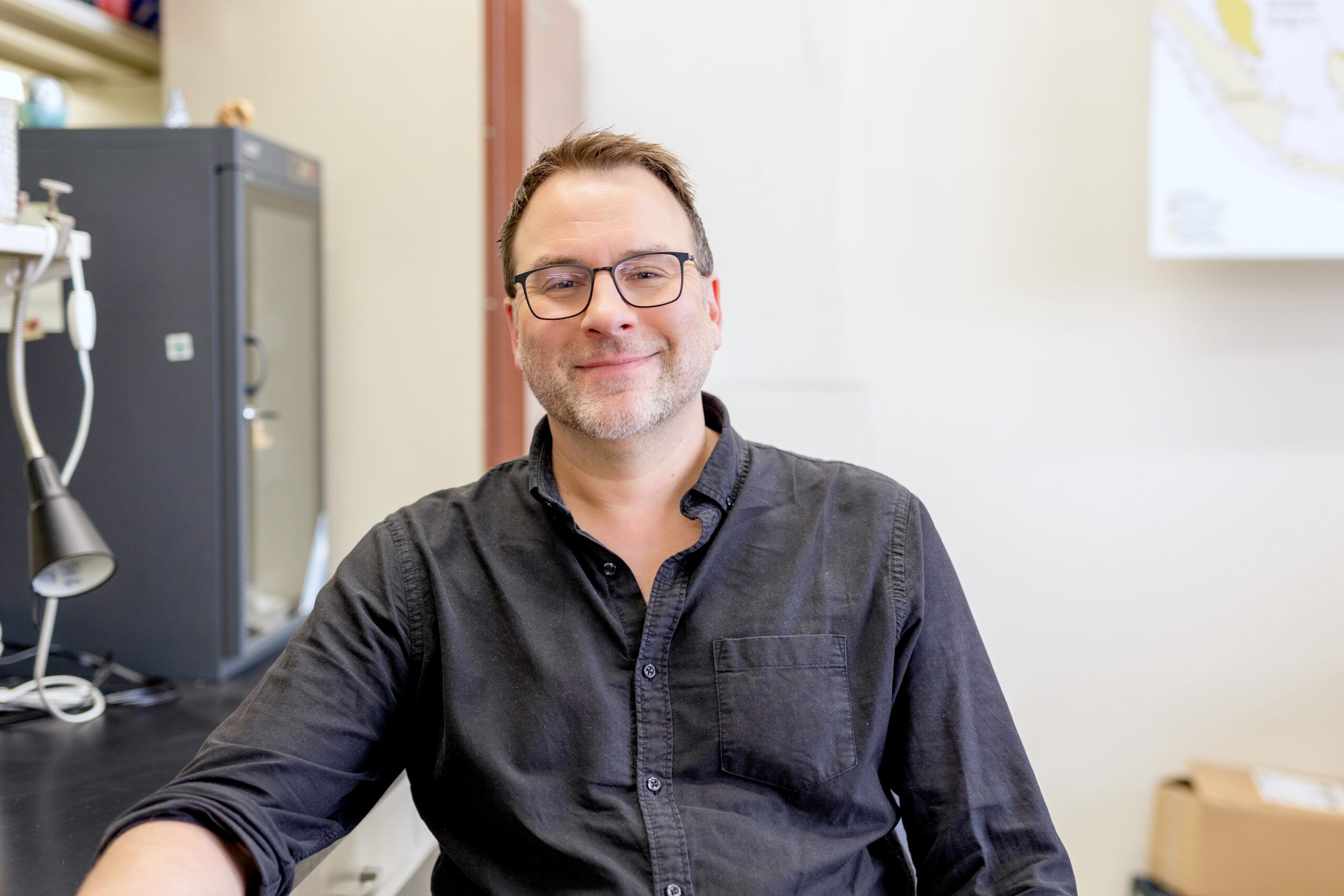
As one of the highest distinctions in the scientific community, being named a Fellow of the American Association for the Advancement of Science recognizes researchers whose work has made a lasting impact in their field. This year, Dr. David Lohman, chair of the Biology Department at City College of New York, was among three CCNY researchers awarded the prestigious lifetime honor for his contributions to the study of butterfly evolution, biogeography, and mimicry in Southeast Asia. A renowned entomologist, National Geographic Explorer, and three-time Fulbright Research Scholar, Lohman has spent years studying the ecology and evolution of insects across the Old World tropics.
When asked what galvanizes his evidently strong work ethic, he quickly shared that his father was a huge inspiration to him. Growing up in Illinois on a farm in a town of 350 people, Lohman saw his father, a farmer, work tirelessly seven days a week, even now at 70 years old. “My mother had always emphasized doing well in school, being a good student…every Saturday we would go to get groceries in town, and we would also go to the library. My brothers and I would all get a great big stack of books, and throughout the week, we’d read all the books and go back the next Saturday and get new ones. And so, we were all brought up reading voraciously. It helped that we barely had any television reception.” Having developed both a deep appreciation for nature and a strong work ethic from an early age, Lohman grew up realizing he wanted to explore the beauty the rest of the world had to offer, and he understood that the only way to make that possible was through hard work and success, something he ultimately achieved tenfold through his internationally recognized scientific career.
For many college students, choosing a major or future career path can feel overwhelming. It is a conversation that students, parents, and academic advisors alike often struggle through. But for some people, passion arrives early and remains unwavering throughout their lives. For David Lohman, that passion was rooted in nature from the very beginning.
“There was no aha moment. I always loved nature, I had sixty pets: salamanders and turtles, fish and lizards, and rabbits. So, I was always interested in animals and exploring in the stream in the forest. How come you don’t find ferns here? But, they’re over here? The sort of ecological questions that I wondered when I was a kid.”
Lohman also credited an influential undergraduate professor at Bradley University, Kelly McConnaughay, as someone who further nurtured and strengthened his fascination with ecology and the natural world, calling her “an incredible professor”. He mentioned later on in the conversation, “I recommend my students to keep two things in mind when trying to pick something to study. One is that you have to love it. The second is to have an eye towards the job market…because every step of academia is more competitive than the last.”
Butterflies offer scientists a unique lens through which to study larger ecological and evolutionary questions, particularly because they are among the most thoroughly documented insect groups in the world.
“There are several ways that the work that I have done and intend to do has a real-world impact. The first is that butterflies are the best known and understood insect group, and insects are more than half of all known species. So, we know a lot about birds and mammals. but we don’t know a lot about insects, and they have a very different biology. By studying butterflies we can work out global trends in tolerance to climate change, to factors affecting diversification to extinction risks and things like this because if we tried to do this on cockroaches or flies forget about it, we probably don’t know half of the species that exist, we don’t know where they live, we don’t know what they eat. But with butterflies we have that information to a greater degree and so we can start to ask more sophisticated questions that are hopefully representative of insects which have been historically understudied.”
On other ecosystems he still hopes to explore, Lohman pointed to the remote islands surrounding New Guinea, regions known for their extraordinary biodiversity and species found nowhere else on Earth. He is inspired in part by evolutionary biologist Ernst Mayr, whose work in the region helped shape modern theories of evolution. The islands are scientifically fascinating and logistically challenging due to their isolation and limited infrastructure. Looking ahead, Lohman hopes to further expand his research on mimicry through a multidisciplinary approach, continuing work that has made him widely recognized in the scientific community.
Lohman is also preparing for an exciting sabbatical year after receiving fellowships to conduct research and work as a Radcliffe Fellow in residence at Harvard University, as well as through a Fulbright fellowship in Thailand. Having spent years conducting fieldwork in Thailand and speaking Thai as a second language, he expressed excitement about returning for several months in 2027 to continue field research in one of the regions that has shaped both his career and his understanding of evolution.

Daniella is a writer and journalism student whose work explores the intersection of research, culture, and communication. She is currently a Writing Assistant at the Research and Innovation Center at City College of New York.