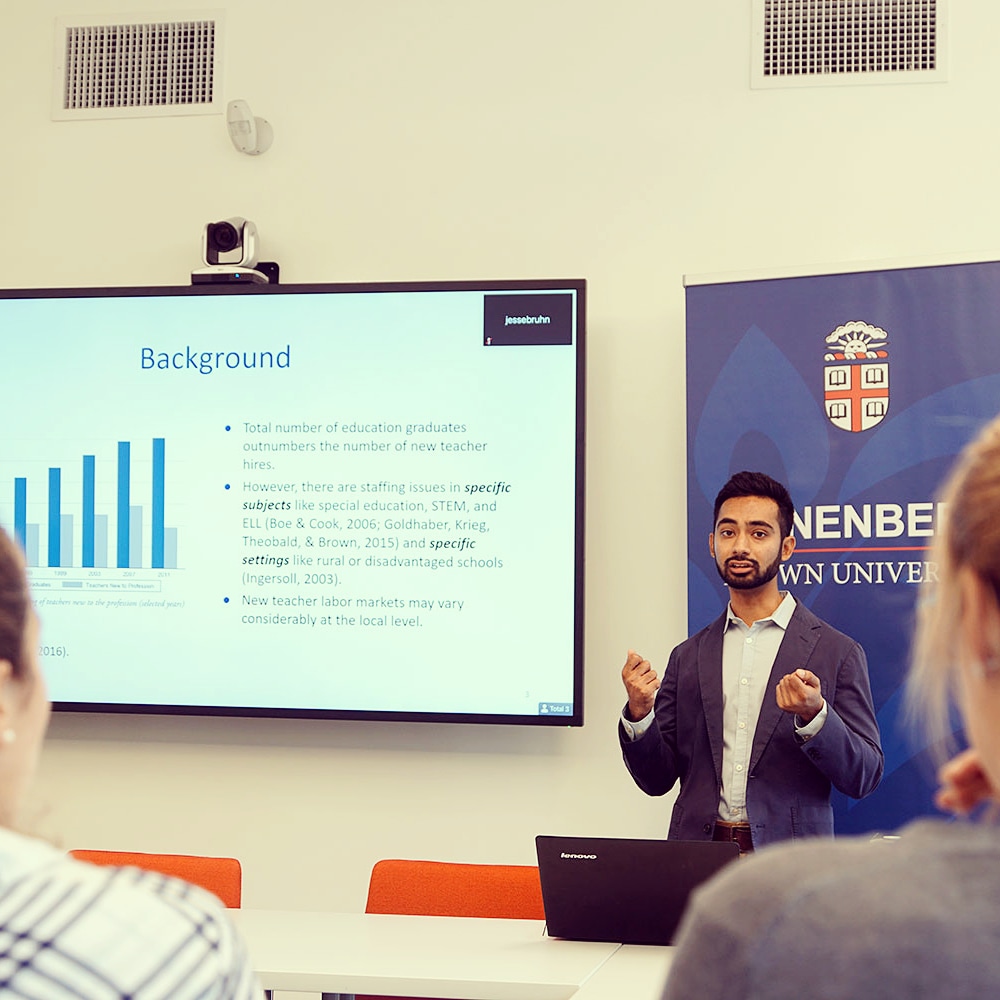
After six years of graduate study, Economist Alvin Christian is getting ready to begin his position as an Assistant Professor of Public Policy at the Rockefeller College of Public Affairs and Policy at SUNY UAlbany.
Since graduating City College in 2016 with a MA/BA in Economics, Christian has gone on to conduct research on domestic violence and the education system, as well as educating on economics and public policy.
Christian uses his life to inform his research. From his time being raised in Brooklyn, to the female presence in his life, he believes that the best projects come from your own personal experience. “I grew up in a family of a lot of women and as a result have had a lot of friends who are women. One in three women are abused over their lifetime. So, I happened to get a lot more exposure, and see that it is a very prevalent and pervasive public health issue,” said Christian. “And growing up in New York City, there’s a lot of variation in the quality of schools that you can attend. I would see how my classmates and my path diverged after attending different schools, which got me really interested in how our education system shaped social mobility.”
This idea has shown itself in many ways throughout Christian’s career. A lot of work goes into taking complex and complicated concepts, and simplifying them for people who may not have background, or even interest, in the topic being discussed.
“One thing that you learn when you’re teaching is that students are coming from a lot of different backgrounds so I want to try to make my teaching as accessible as possible. And because I do research on education and domestic violence, I want to make it accessible to not only economists, but sociologists, political scientists, and policymakers,” he said.
Accessibility is at the center of Christian’s current research project: Academic Accommodation Usage in Higher Education. In partnership with his peer, Arkey Barnett, Christian evaluated who uses academic accommodations. His findings pointed to Asian students and men being the least likely to use these accommodations, while white students and women were most likely. Additionally, he found that there is a U-shaped pattern with the Socioeconomic Status (SES) where low-income and high-income students were more likely to use them versus their middle-income peers. He has plans to further develop this research through connecting with disability offices and observing his own classroom settings at SUNY UAlbany.
In his time studying economics at City College, Christian recalled three significant professors that shaped his understanding of the study and how he could apply his skills. An Introduction to Macroeconomics course with Professor Marta Bengoa and an Econometrics class with Professor Kevin Foster affirmed his capabilities and interest in the study. His time working as a research assistant of Professor Prabal K. De broadened his understanding of what economists can study, having people and healthcare at the focus of his work. “I didn’t know that you could study people. I thought you’d always study interest rates, the GDP, or things like that. It was really cool to learn how to tell a human-centric kind of story with data, not only focusing on abstract concepts,” he said.
“Especially coming from a NYC working class family, the professors that I met did a really good job of meeting me where I was at and giving opportunities to get to my greatest potential. I don’t think I would have done that based on my background.”
Christian believes that one of the more impactful things he did outside of the classroom while attending CCNY was his participation in the Colin Powell Fellowship in Leadership and Public Service. “The MPA program at CCNY in particular sent students to D.C. I was able to get free housing and an internship where I was doing economic policy research and working at a think tank. And I learned that I don’t actually like working in politics very much, which was great to learn at 19 or 20.”
Christian would encourage students pursuing similar studies to not only talk to people that are in their field of interest. They should talk to people who thought about following that career path but did not ultimately end up in that line of work. He stated, “Their advice is probably just as valuable because you get a much fuller picture of what you’re getting yourself into.”
In his own journey, he was given advice that stuck with him: “Five years are going to go by anyway, you might as well do something in those five years that you find worthwhile, whether you’re choosing a career path, going back to school, or deciding on a long-term project.”

Natalie Elysse Moreno is an interdisciplinary artist working to develop journalistic work through a creative lens. Natalie is an undergraduate student at The City College of New York, pursuing a double major degree in Journalism and Latin American Studies with a minor in English. While at CCNY, she has found her voice through storytelling, primarily enjoying writing articles centered on community and sustainability as well as creative essays about her life experiences. She’s had worked with Harlem View, the HIPE Network, BronxNet, and WHCR 90.3 Fm.