Recent research exploring how light can manipulate the properties of materials is expanding the boundaries of modern physics. At the center of that work is Dr. Vinod Menon, a professor of Physics at CCNY and the CUNY Graduate Center, who was recently named a 2025 Fellow of the American Association for the Advancement of Science for his distinguished contributions to strong light-matter interactions.
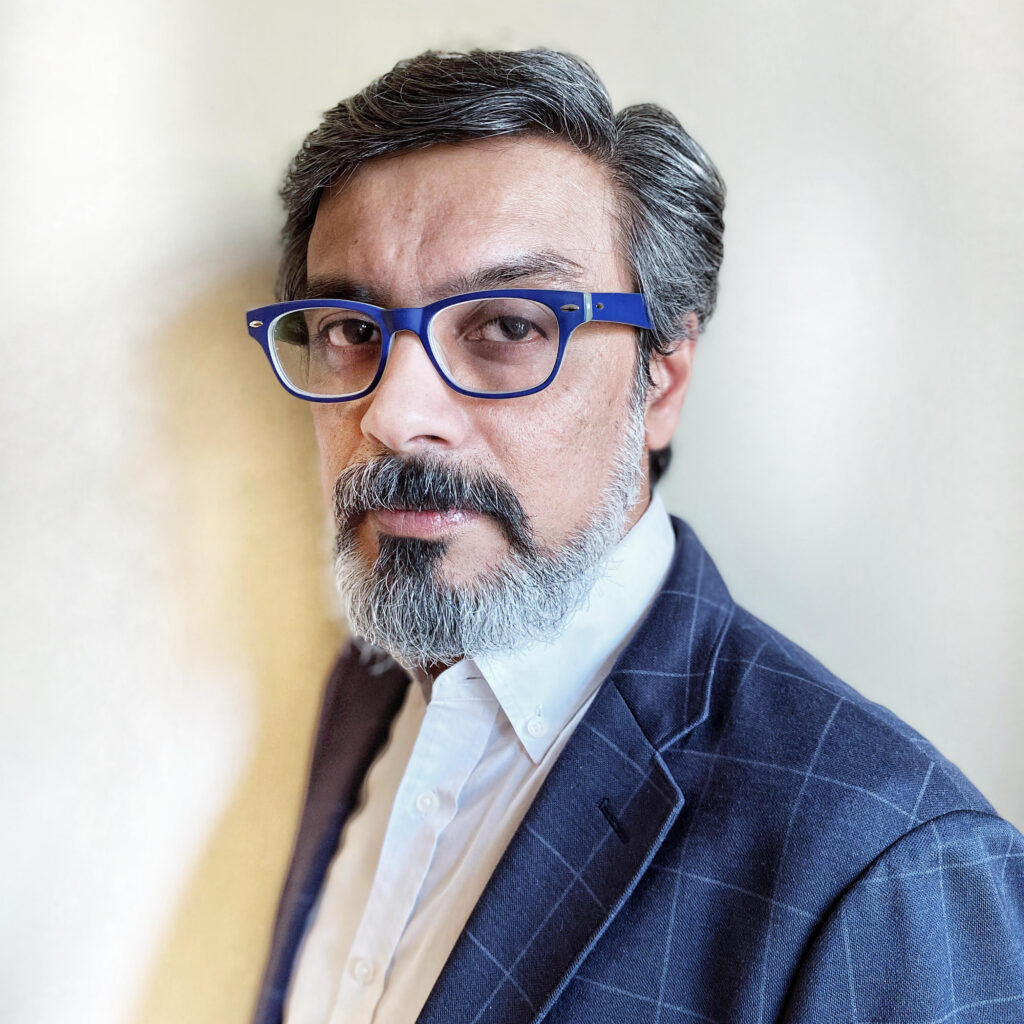
Dr. Vinod Menon. Photo Credit: Courtesy of Dr. Menon.
The recognition highlights Menon’s years of research in photonics, quantum materials and condensed matter physics, fields that could help shape the future of quantum computing and next-generation communication technologies.
Menon, who completed his undergraduate and master’s studies in India before moving to the United States for his Ph.D. studies at the University of Massachusetts, was drawn to City College for both its institutional mission and its longstanding reputation in physics research.
His work now centers on understanding how light interacts with atomically thin materials, also known as two-dimensional materials. According to Menon, the emergence of these materials has transformed modern solid-state physics by making advanced experimentation more accessible to researchers.
One of the breakthroughs recognized by the AAAS Fellowship involved Menon’s research demonstrating how light interacts with these ultra-thin materials to create hybrid quasiparticles that behave as both light and matter. The work showed, for the first time, that these interactions could occur at room temperature.
“The discovery of atomically thin materials has really changed the way we do a lot of solid-state physics these days,” Menon said.
In addition to theoretical significance, Menon said the research could have practical implications in both classical and quantum information processing. More recently, his Laboratory for Nano and Micro Photonics (LaNMP) has developed new methods for converting microwave photons into near-infrared light, addressing a longstanding challenge in the development of quantum communication networks.
While the AAAS Fellowship recognizes his scientific accomplishments, Menon emphasized that the award reflects the contributions of many collaborators, students and mentors throughout his career.
“It’s really a recognition for all my students and postdocs and collaborators who have worked with me,” Menon said. “So I really consider it a collective effort.”
Menon added that the recognition also highlights the quality of scientific research at CCNY and across CUNY campuses. He emphasized that access to advanced research facilities, including laboratories at the CUNY Advanced Science Research Center and the CUNY Center for Discovery and Innovation, has enabled his group to pursue the work recognized today.
“We are uniquely blessed,” Menon said. “We have great students and experimental facilities in my own lab, but we also have access to state-of-the-art facilities and interdisciplinary collaborations.”
The fellowship also carries expectations for future innovation. Menon’s current research investigates whether one can alter the properties of materials not by changing the material itself, but by modifying the surrounding electromagnetic environment, which is an emerging approach that could redefine how future materials and quantum technologies are engineered.
“Normally, material science is done by changing the atoms,” Menon said. “Now we are saying we don’t want to touch the material itself, but let’s change what happens surrounding it, and that should change the material’s response, which is a very exciting direction to pursue.”
This innovative, high-risk research direction recently received funding support from the Gordon and Betty Moore Foundation and the W. M. Keck Foundation.
“I’m really glad that I have all this support,” Menon said. “There is all this infrastructure, scholars, and facilities here to pursue real world-class research.”
As research in quantum information processing and quantum materials continues to grow, Menon said he hopes to continue advancing world-class scientific work in the field at CCNY.

Sofia is a graduate student at CUNY Brooklyn College, where she’s pursuing her M.S. in Media Studies. Her work centers on cultural affairs, capturing people’s lived experiences, and producing work that is not only compelling and polished but also intentional, inclusive, and aligned with meaningful public impact. In addition to writing for The RICC, she’s a dedicated writer for the Brooklyn News Service.