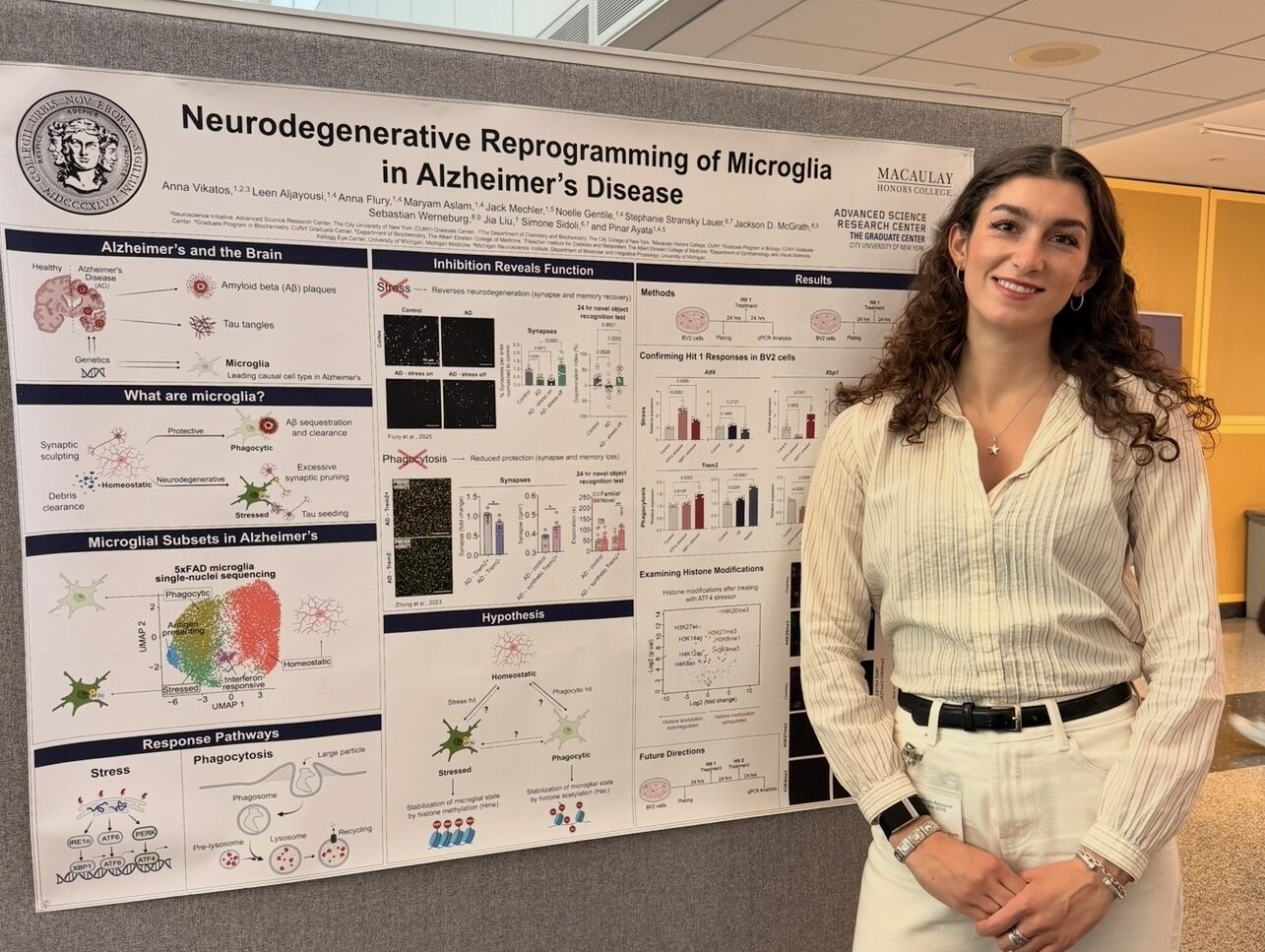
For a second year in a row, Anna Vikatos, a June bio-chemistry graduate and CCNY Division of Science salutatorian, has presented her research project, “Neurodegenerative Reprogramming of Microglia in Alzheimer’s Disease” at the CUNY Celebration of Undergraduate Research.
The research was conducted under the tutelage of professor Pinar Ayata at the Advanced Science Research Center. The Ayata Lab investigates how microglia, immune cells located in the brain and spinal cord, respond to misfolded protein aggregates, the trigger of most neurodegenerative diseases, such as Alzheimer’s disease.
Vikatos’ work builds on previous research done by the Ayata Lab that discovered a conserved stress signaling pathway, the integrated stress response (ISR), characterizes a microglia subset with neurodegenerative outcomes. For Vikatos’ project, she researched how stress alters microglial function.
“She performed experiments demonstrating that repeated ISR activation induces a form of microglial sensitization accompanied by widespread epigenetic changes, including increased DNA methylation and repressive histone methylation. Importantly, Anna demonstrated both in vitro and in vivo that metabolite levels mediate ISR-induced epigenetic remodeling and microglial sensitization,” Ayata said.
Working alongside PhD students, Vikatos and her colleagues found how the microglial states can diverge in Alzheimer’s disease depending on which stimuli it is exposed to. Vikatos hopes that her research could illuminate ways in which microglia can function beneficially in neurodegenerative diseases.
“Further work that I’d want to do for my project would be to look more into the protective roles,” Vikatos said. “If microglia are able to occupy a stress state that exacerbates the disease, I want to see if they can also shift towards a more protective state, which is how they normally function by clearing debris between synapses and breaking down amyloid plaques.”
Vikatos knew she wanted to become a scientist when she began working alongside her mother at their family-owned pharmacy. As a teenager, she began looking for labs in which to work, hoping to find one researching Alzheimer’s disease, as her great-grandmother was afflicted with the ailment.
Vikatos’s first experience doing research took place in high school when she did lab work at the Feinstein Institutes for Medical Research studying the vagus nerve. As it took place during the pandemic and was remote, Vikatos sought hands-on experience in a lab when she came to City College. Knowing she wanted to conduct research related to the brain, she reached out to the Ayata Lab where she landed a role as a research assistant.
“Although she joined my laboratory with limited prior experience in neuroscience, she quickly adapted to a challenging research environment and demonstrated remarkable initiative, curiosity, and independence,” Ayata said.
Vikatos was recruited by City College to play basketball. Since she was also accepted into the Macaulay Honors Program, CCNY seemed like the natural choice, especially since she knew she always wanted to be a doctor and go to a research-focused school. Since graduating, Vikatos has been applying to medical school hoping to eventually become a neurologist.
“I learned and grew so much from this experience, and I am deeply appreciative of the opportunity as I continue pursuing a career in medicine.” Vikatos said.
Yadira Gonzalez is a graduate of Baruch College where she studied journalism and minored in film. She was an editor-in-chief of Baruch’s award-winning magazine Dollars and Sense. Her writing has also been published in Documented, The New York Review of Books and AdAge.