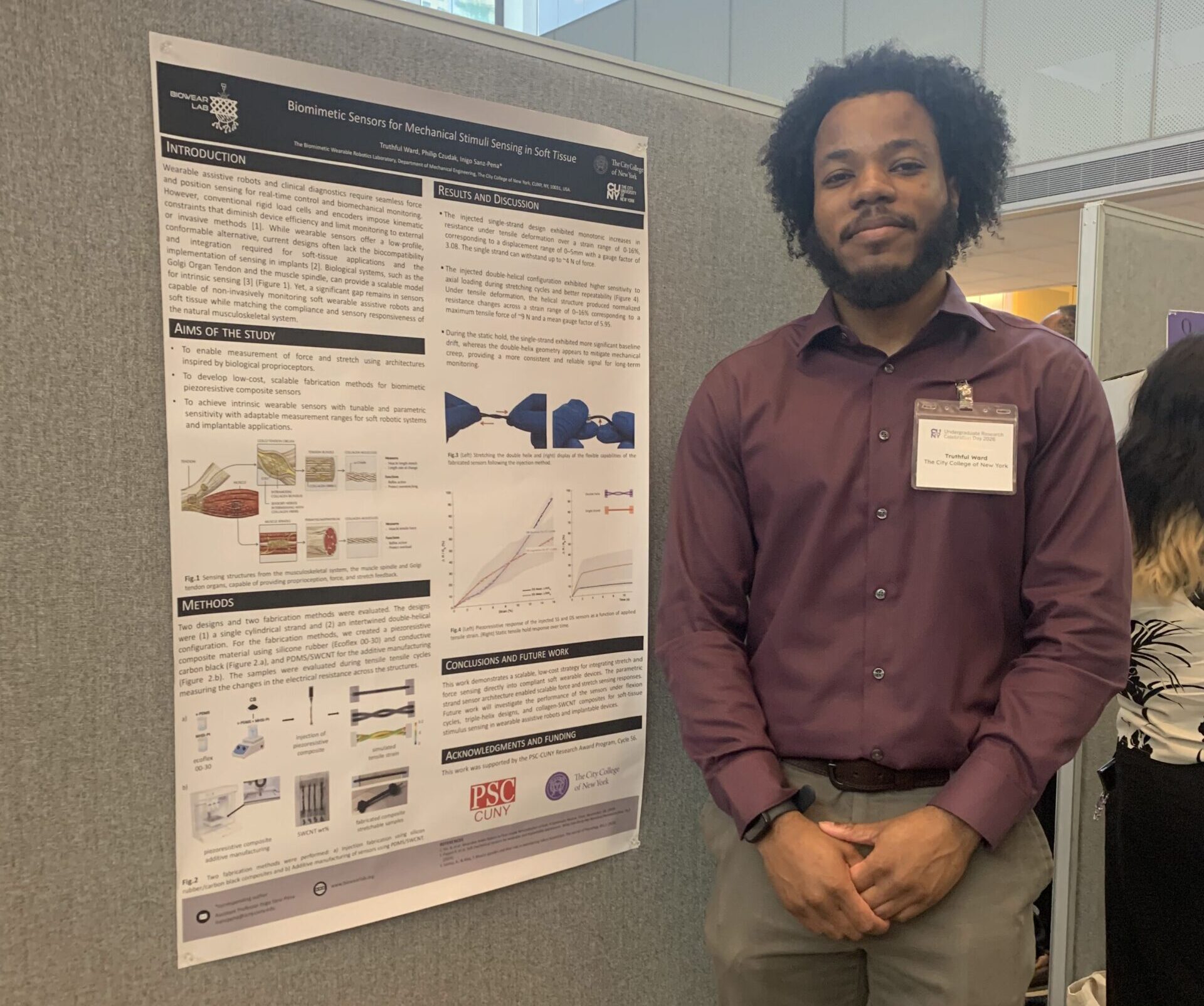
 When biomedical engineering student Truthful Ward was younger, he saw movies like iRobot and Star Wars where the prevalence of assistive robots demonstrated the possibility of a world buzzing with productivity– yet remained a thing of the future.
His project at the CUNY Celebration of Undergraduate Research, “Biomimetic Force and Stretch Proprioceptive Sensors for Soft Wearable Assistive Robots using a Piezoresistive Elastomer Composite” hints that the ubiquity of these helpful devices could soon be a reality.
Ward’s project focused on the fabrication of sensors that mimic the sensory receptors in a biological system. He focused on replicating the mechanisms of the Golgi tendon and the muscle spindle. Both are proprioceptors that tell the body how much tension its muscles are exerting and how far it can stretch, respectively.
By imitating these structures inherent in the human body instead of using cumbersome technologies like load cells, these wearable assistive robots are a lightweight, low-cost alternative that detect force more comfortably and efficiently.
“[Conventional sensors] are a lot more bulky in terms of detecting force and that can hinder the overall movement of whatever type of robot you have or exoskeleton, depending on what your application is. So in this case making something that has already been seen to work in us is the novelty of the study,” Ward said.
Over the course of three semesters, Ward spent his time troubleshooting multiple versions of the product. The process consisted of combining carbon black to silicone rubber elastomers to develop piezoresistive composite sensors which change in their electrical resistivity when a mechanical strain is put on them. Ward worked alongside graduate students and his mentor Inigo Sanz-Pena, a professor at the Department of Mechanical Engineering whose research focuses on biomimetic robots and devices.
“Truthful was instrumental in laying the experimental groundwork for this project, taking ownership of the fabrication from initial proof-of-concept samples through several iterations and fabrication methods, culminating in the working solution,” said Sanz-Pena.
Despite having previously worked as an apprentice developing prototypes and understanding fabrication equipment, Ward admits that working on biomedical technology was a unique experience.
“It was a change. It was a new thing for me to work as a researcher in a lab,” Ward said. “You need a little audacity, even if you’re not the most prepared and whatever belief you have of what your skillset is, just try.”
He and Sanz-Pena suggest that students interested in doing research as undergraduates can be daunting but also a fulfilling experience. “Research is inherently unpredictable, and things rarely work on the first try. Staying dedicated through that uncertainty is the only way to achieve meaningful findings and build technical skills,” Sanz-Pena said.
Ward hopes to continue working on a finished project, outlining an application for the sensors and performing tests that demonstrate effectiveness for wearable prosthetics. He also hopes to eventually pursue a master’s degree and continue studying engineering.
“I definitely want to continue to pursue higher education and get some more opportunities to develop some pretty awesome products in the future,” Ward said.
Yadira Gonzalez is a graduate of Baruch College where she studied journalism and minored in film. She was an editor-in-chief of Baruch’s award-winning magazine Dollars and Sense. Her writing has also been published in Documented, The New York Review of Books and AdAge.