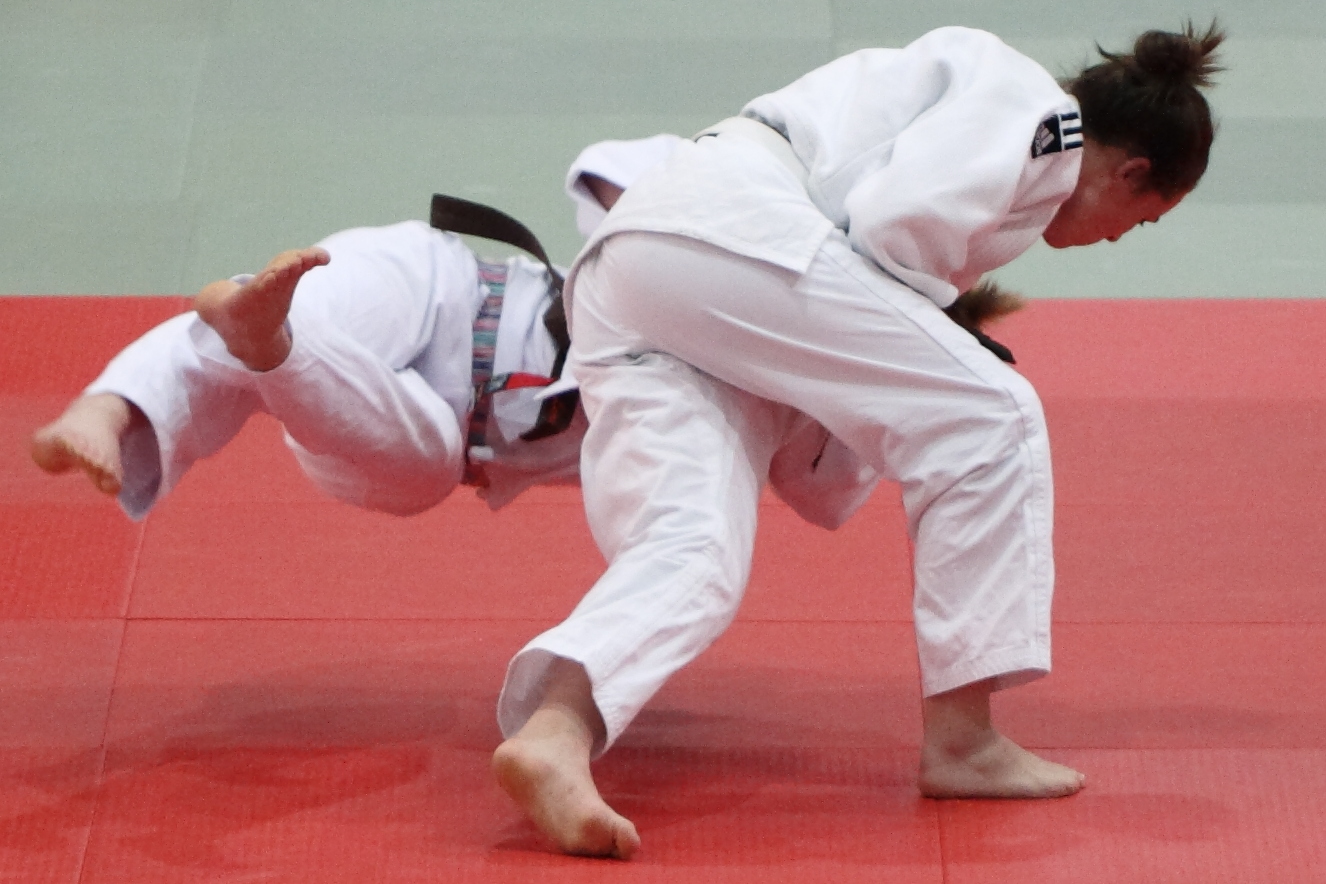
In an effort to make Judo a more accessible practice, Ken Pardo, a Queens College CUNY B.A. Neuroscience student-researcher, has begun cross-examining Judo strategies and body physique to support Judokas in their training. With experience in hand-to-hand combat as a wrestler, Pardo has been leading the investigation of this correlation by quantitatively analyzing tournament winners’ body structures and their associated behaviors along with fellow interns.
“It’s significant because it leads us to be able to create a sort of dictionary of strategies by developing a comprehensive understanding of behaviors associated with body structures.”
“This will hopefully be useful for any martial artists who maybe can’t reach out and get a really expensive training that typically is offered throughout martial arts,” said Pardo. “The end goal of this is to develop something new because everyone will already knows the strategy. It forces you to develop new, more creative strategies which allows us to continue doing research.”
As their research develops, so do their research strategies. Through a tool called Pose Estimation, the interns are better equipped to analyze a player’s exoskeletons to examine specific limb lengths and question whether that enables more or less of a specific move. Then, analyzing behavior patterns and body measurements. Pardo and the team are not planning to stop at Judo.“This won’t just be present in Judo, we’re hoping to extend our reach to different sports. We were talking about golf, looking at their posture and tennis, looking at their batting skills. This can be extended to a lot of different areas if applied correctly to sports that examine posture specifically.”
“It’s a double-sided sword because it would be useful to have a mentor like a graduate student or a PhD student who’s doing the same type of research. But it teaches you how to be creative and retrospectively think about other tools that could be applied to other sorts of subjects and look to see how to apply those here.”
In partnership with his mentor, Sebastian Alvarado, whom he was partnered with during his CUNY Career Launch summer internship program, Pardo is expanding his neuroscience lab experience. His internship is part of a collaboration between Dr. Maral Tajerian and Alvarado at Queens College, where they are adapting tools from behavioral analysis, posture tracking, and machine learning to study human movement.
“Ken helped analyze judo competitions, including the All Japan Judo Championship, where open-weight competition allows us to ask interesting questions about how size, weight class, and strategy shape movement patterns and outcomes,” said Alvarado. “His athletic background gave him a valuable perspective for recognizing and scoring meaningful behaviors, and his work helped establish the foundation for this emerging area of research in the lab.”
Like many students, Pardo faced imposter syndrome when he first pursued research, constantly asking himself if he was ready enough for the journey.
“I think it’s just easier to put yourself there and then figure it out, which is scarier to say. The biggest thing that occurs is that feeling of ‘Oh, I wish I started this 5 years earlier, that way I wouldn’t have only one year left, or have more opportunities to participate in,” said Pardo.
“I don’t think that it should be as scary as it is because we need more researchers and we need more people in the science field willing to go take these tests.”
A piece of advice from both Pardo and his mentor that stands out is the act of reaching out and creating a connection with participants and faculty in specific labs. As well as engaging in CUNY- and academic-centered programs, such as URISE, CCAPP, and AMSNY, that support mentorship, funding, and research – all of which Pardo has participated in.
“Every lab has its own culture, expectations, and mentorship style, so students should ask what undergraduates actually get to do, whether there are opportunities to present at conferences or contribute to publications, what skills they will learn, and what level of commitment is expected,” said Alvarado.
“Ken is a good example of how a student can be supported by their home institution while conducting research at another CUNY campus when there is a strong fit.”

Natalie Elysse Moreno is an interdisciplinary artist working to develop journalistic work through a creative lens. Natalie is an undergraduate student at The City College of New York, pursuing a double major degree in Journalism and Latin American Studies with a minor in English. While at CCNY, she has found her voice through storytelling, primarily enjoying writing articles centered on community and sustainability as well as creative essays about her life experiences. She’s had worked with Harlem View, the HIPE Network, BronxNet, and WHCR 90.3 Fm.