
As quantum computing advances, ensuring these emerging systems are trustworthy has become an increasingly important research challenge. At CCNY, Dr. Samah Saeed, associate professor of electrical engineering at the Grove School of Engineering and director of the Security and System Reliability Laboratory (SERS), is investigating how security and system reliability can be built into the development of growing quantum-computing technologies.
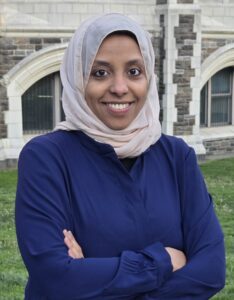
Dr. Samah Saeed. Photo Credit: Courtesy of Dr. Saeed.
That work is now being advanced through Saeed’s National Science Foundation CAREER Award for her project, “Towards Secure and Reliable Cloud-Based Quantum Computers.” The project builds on her background in hardware security and testing to investigate security challenges unique to quantum computing and develop practical defenses for current and emerging cloud-based quantum systems.
“Personally, this award represents meaningful recognition of the research my students and I have pursued over the past several years,” Saeed said. “Professionally, the award gives us the opportunity to establish a sustained research program in quantum-system security.
Saeed earned her Ph.D. in computer science from NYU Tandon School of Engineering, where her research focused on testing – integrated circuits and hardware security. After completing her doctorate, she left New York but continued collaborating with NYU researchers on the security of emerging technologies and reversible computing.
That work eventually brought her back to NYC and to CCNY, where she began investigating quantum computing as an application of reversible computing. Drawing on her previous research, Saeed expanded her focus to the reliability and security of quantum systems and established the SERS Laboratory, with quantum systems as one of its primary research areas.
Her CAREER project addresses what Saeed describes as a gap between the rapid development of quantum technology and the attention being paid to the security of the systems supporting it.
“There has been significant investment in developing quantum hardware and software in both academia and industry, but the security of the underlying quantum-computing system has received comparatively less attention,” Saeed said. “This CAREER project aims to address that gap and help enable secure and reliable next-generation cloud-based quantum computers.”
As researchers often access quantum computers remotely through the cloud and share hardware with other users, they have limited visibility into how that hardware is behaving. Saeed’s project examines potential threats involving malicious circuit developers, adversarial users sharing hardware, and insiders at quantum-computing vendors or cloud providers.
The research seeks to identify attack vectors specific to quantum systems and develop defenses against them. These approaches include runtime detection techniques, along with security-aware quantum-circuit synthesis and design strategies. The goal is to protect the integrity and confidentiality of quantum computations while maintaining low overhead on existing and emerging quantum hardware.
The CAREER Award also allows Saeed to build on research collaborations and previous projects. Her work with Lawrence Berkeley National Laboratory has helped her group address research questions involving quantum circuit optimization and efficient execution on current quantum hardware. A seed grant from Google through Google Cyber NYC also supported research into embedding information into quantum circuits as a lightweight security mechanism to help detect unauthorized distribution of quantum programs.
For Saeed, however, advancing the technology is only one part of the project.
“Students are at the core of this CAREER project,” Saeed said. “My research has always been driven by both graduate and undergraduate researchers, who help formulate research questions, develop solutions, and experimentally validate our proposed methods.”
Through the project, Saeed plans to continue recruiting undergraduate and graduate researchers while creating opportunities extending from high school through graduate education. The educational component includes new curriculum and course modules, summer research, mentoring, outreach, hackathons and security challenges.
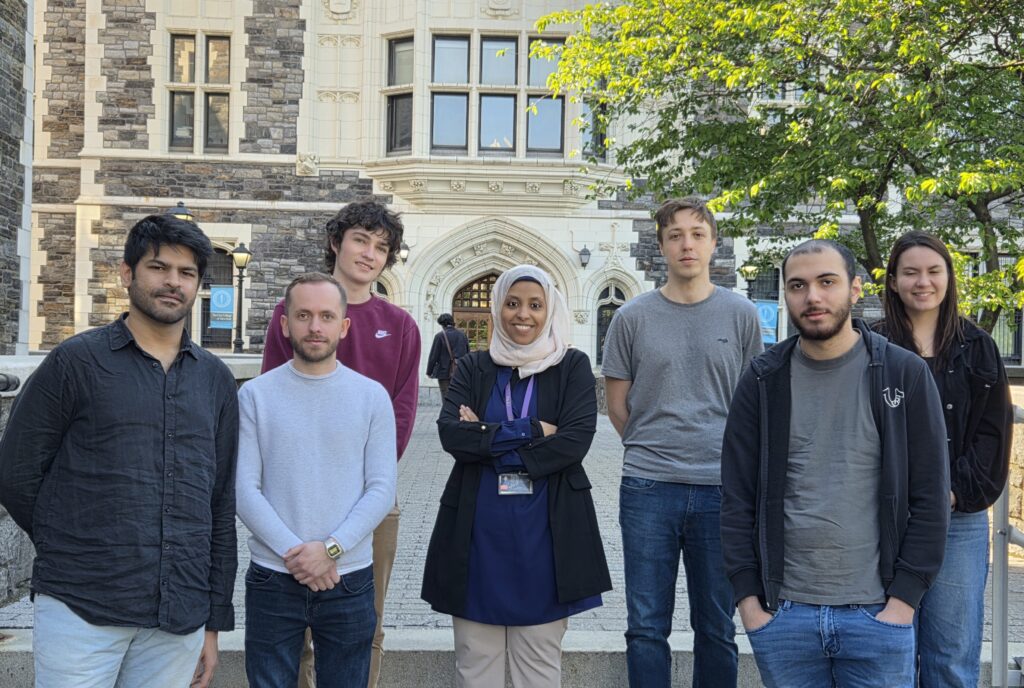
Dr. Saeed and her research group. Photo Credit: Courtesy of Dr. Saeed.
At CCNY, undergraduate students will also have opportunities to participate through programs like the City College Initiative to Promote Academic Success in STEM. Graduate researchers will develop leadership skills, present research at conferences, mentor undergraduate students and help organize security competitions and challenges.
“I want to create a research-training environment in which students are not simply assisting with experiments, but are learning how to formulate research questions, design methods, analyze data, and communicate scientific results,” Saeed said.
That emphasis also supports Saeed’s goal of broadening participation in quantum technology and developing pathways for students from diverse backgrounds to enter an emerging quantum-cybersecurity workforce.
Beyond the CAREER project, Saeed is currently working on two Department of Energy projects, including one she leads, involving physically aware software stacks for quantum computing systems and heterogeneous quantum-computing ecosystems. She is also leading an Air Force Research Laboratory project examining scalable, reliable and secure quantum-networked applications. Together, the projects contribute to what Saeed describes as a broader vision for scalable, reliable and secure quantum systems.
Looking ahead, she wishes the CAREER project will help shift security from an afterthought to a fundamental part of quantum-computing design and that the research can move beyond academic prototypes and contribute to tools that commercial quantum-computing vendors can implement.
“I hope this NSF CAREER project will help make security integral to the design of cloud-based quantum computers, rather than treating it as a feature added after these systems become widely deployed,” Saeed said.

Sofia is a graduate student at CUNY Brooklyn College, where she’s pursuing her M.S. in Media Studies. Her work centers on cultural affairs, capturing people’s lived experiences, and producing work that is not only compelling and polished but also intentional, inclusive, and aligned with meaningful public impact. In addition to writing for The RICC, she’s a dedicated writer for the Brooklyn News Service.