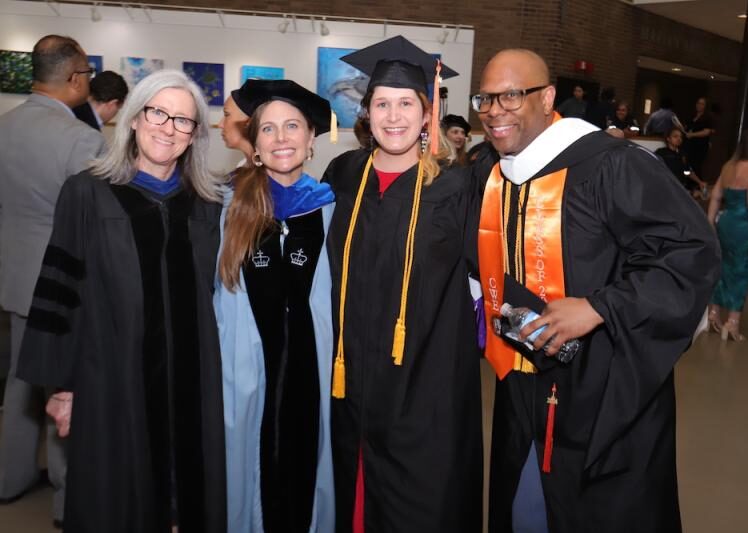
At CCNY, an innovative accelerated graduate degree program invites students to fast-track their education, earning both a bachelor’s and a master’s degree in just five years while exploring the urgent and interconnected matters of migration, race, inequality, and identity that shape history.
The 4+1 pathway within the Study of the Americas graduate program is housed in the Division of Interdisciplinary Studies at the Center for Worker Education (CWE) and led by its director and associate professor of anthropology, Dr. Susanna Rosenbaum.
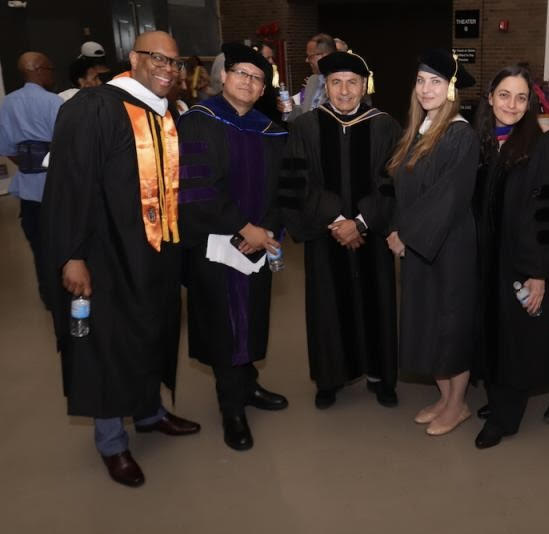
Graduation 2024, from left to right, Chuck Thornton (4+1 grad), Prof Carlos Aguasaco, Dean Juan Carlos Mercado, Prof. Danielle Zach, Dr. Susanna Rosenbaum. Photo Credit: Courtesy of Dr. Rosenbaum.
The pathway allows undergraduate students in the B.A. Interdisciplinary Arts & Sciences or in the B.A. Social Justice and Urban Life programs to begin taking graduate-level courses early and complete an M.A. one year after earning their bachelor’s degree.
“We are deeply rooted in interdisciplinary studies and our students learn that different parts of the Americas can’t really be understood in isolation,” said Rosenbaum, “the histories, cultures and inequalities across the hemisphere are all tied together.”
Rosenbaum emphasized that the interdisciplinary structure of the program encourages students to critically examine the connections between histories and cultures across North, Central and South America, and the Caribbean and to understand their impact.
The program draws from different fields, including anthropology, political science, Black studies, history, geography, literature, sociology, and urban studies. The students in the 4+1 pathway can apply up to 12 graduate credits toward both their undergraduate and graduate degrees, which reduces the time and cost typically required to earn a master’s degree.
“We wanted to make graduate education more financially and academically accessible for working students,” Rosenbaum said. “It also gives students the opportunity to save both time and money while they earn an additional credential”.
The program is designed with working students in mind, reflecting the mission of the CWE, and holds classes in lower Manhattan as well as online. The courses are seminar-based and emphasize research, analytical thinking and discussion-driven learning.
“What we’re really interested in is developing deep critical thinking skills, writing skills, research skills,” Rosenbaum said. “All of our classes are seminars, and so you really get a chance to engage deeply with the material.”
For Vrndavana Lila, a current student in the 4+1 pathway, the program became an opportunity for both intellectual and personal transformation.
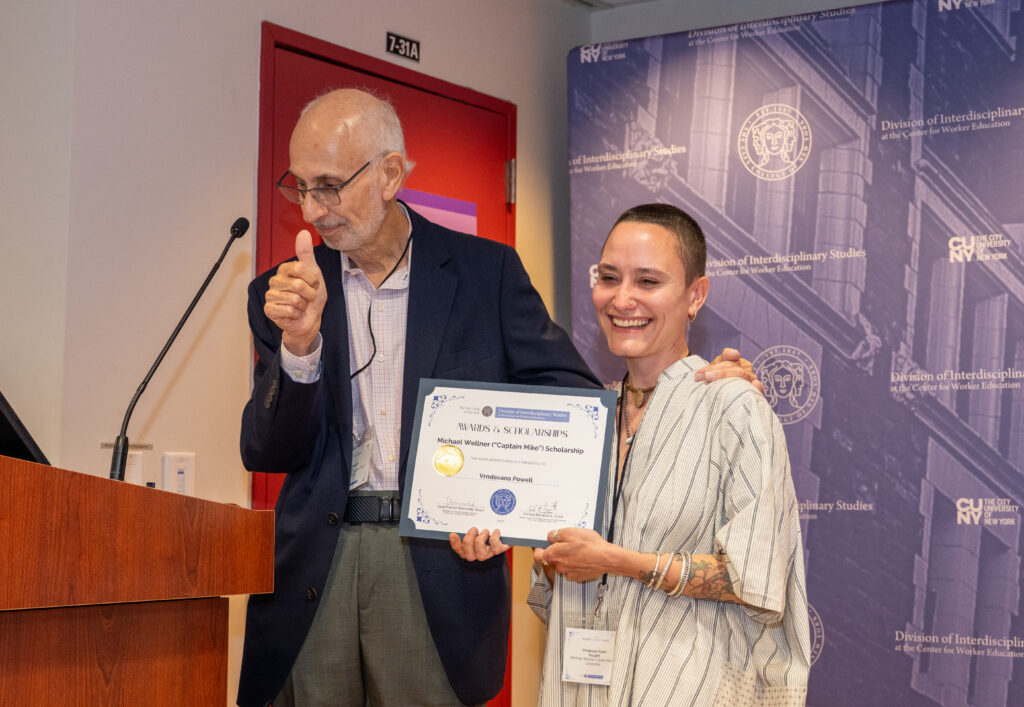
May 2026: Michael Wellner (donor) and Vrndavana Powell (4+1 student) at IAS Divisional Awards Ceremony. Photo Credit: Courtesy of Dr. Rosenbaum.
Lila, a self-taught artist, writer and musician, returned to school 15 years after graduating high school and is currently completing an undergraduate degree in Interdisciplinary Arts and Sciences while enrolled in the 4+1 accelerated Study of the Americas master’s program.
“I fell in love with CWE and the education that I was receiving,” Lila said. “The Study of the Americas program hits on all points of interest, and I intuitively felt that if I pursued that path, I would receive the most robust education to carry me forward in my academic and creative pursuits.”
Lila said the program helped shape new academic goals, including an interest in pursuing cultural anthropology and eventually earning a doctorate degree.
“My studies have been a profound catalyst for internal and external growth,” Lila said.
The program’s professors also encourage students to connect classroom learning with applied research and community-based projects. Rosenbaum said students have recently participated in initiatives focused on sustainability, labor and social justice across the Americas.
Through a capstone course and an independent study with Professor Susanna Schaller, two students collaborated with La Organización de Mujeres Mano de Tigre – Orcuo Dbon, an Indigenous women’s association in Térraba, Costa Rica. The students helped develop grant proposal modules focused on land tenure rights and permaculture training to address violence against Indigenous land activists and issues over communal land rights.
In another project, a student working with Professor Kathlene McDonald through the CUNY Office of Research, Creativity and Arts collected oral histories examining care work as a barrier to social mobility for CUNY students. The student later helped transcribe and archive the interviews as part of the Labor of Care Archive.
Other students have explored topics such as digital labor, precarity and bureaucracy through long-term research projects developed across multiple courses.
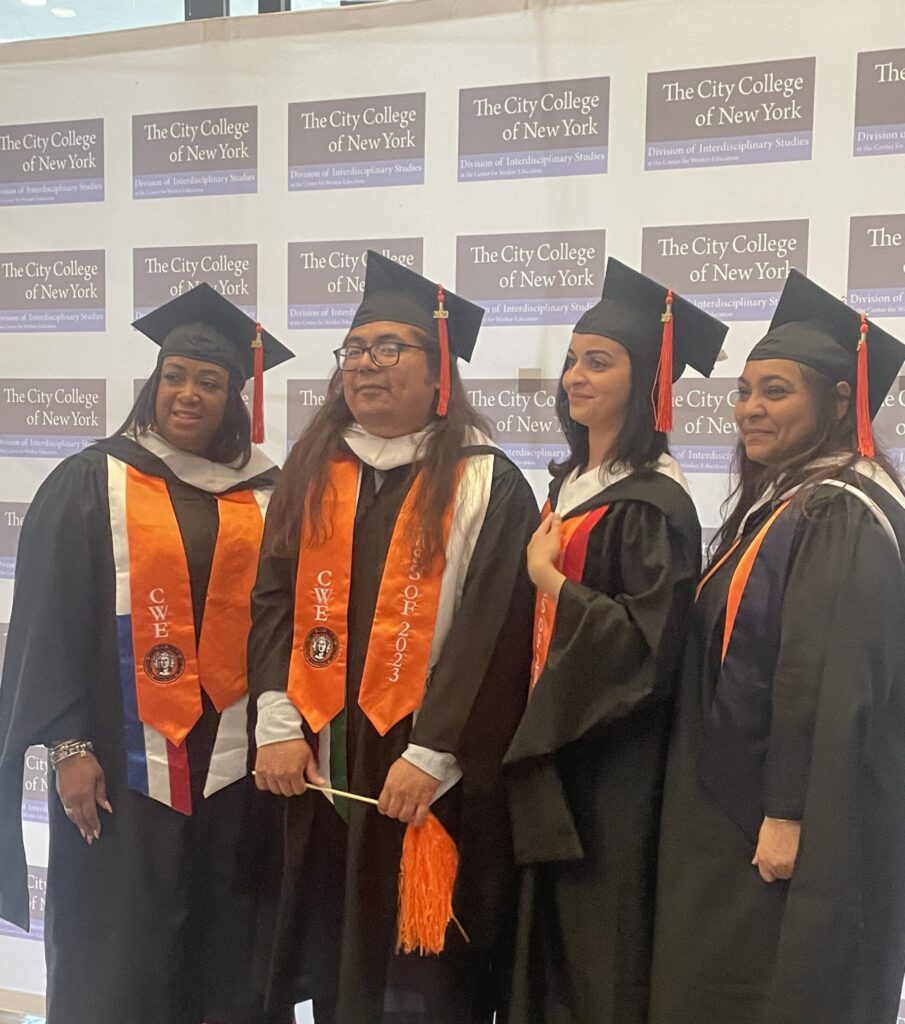
Graduation 2023, from left to right, Yainel Pena-Furment (MA grad), Flavio Perez (MA grad), Janet Sanchez (4+1 grad). Photo Credit: Courtesy of Dr. Rosenbaum.
The department is also preparing to launch a new partnership with the United Nations University hub at City College with a focus on urban sustainability in the Americas. The initiative will allow students to earn both an M.A. in the Study of the Americas and a diploma from the U.N. University while studying sustainability from social, political and policy perspectives.
Rosenbaum emphasized that expanding opportunities while continuing to attract more students remains one of the program’s central goals.
“We would love more students so they can discover new ways of understanding the world and realize they can contribute to changing it,” she said.

Sofia is a graduate student at CUNY Brooklyn College, where she’s pursuing her M.S. in Media Studies. Her work centers on cultural affairs, capturing people’s lived experiences, and producing work that is not only compelling and polished but also intentional, inclusive, and aligned with meaningful public impact. In addition to writing for The RICC, she’s a dedicated writer for the Brooklyn News Service.