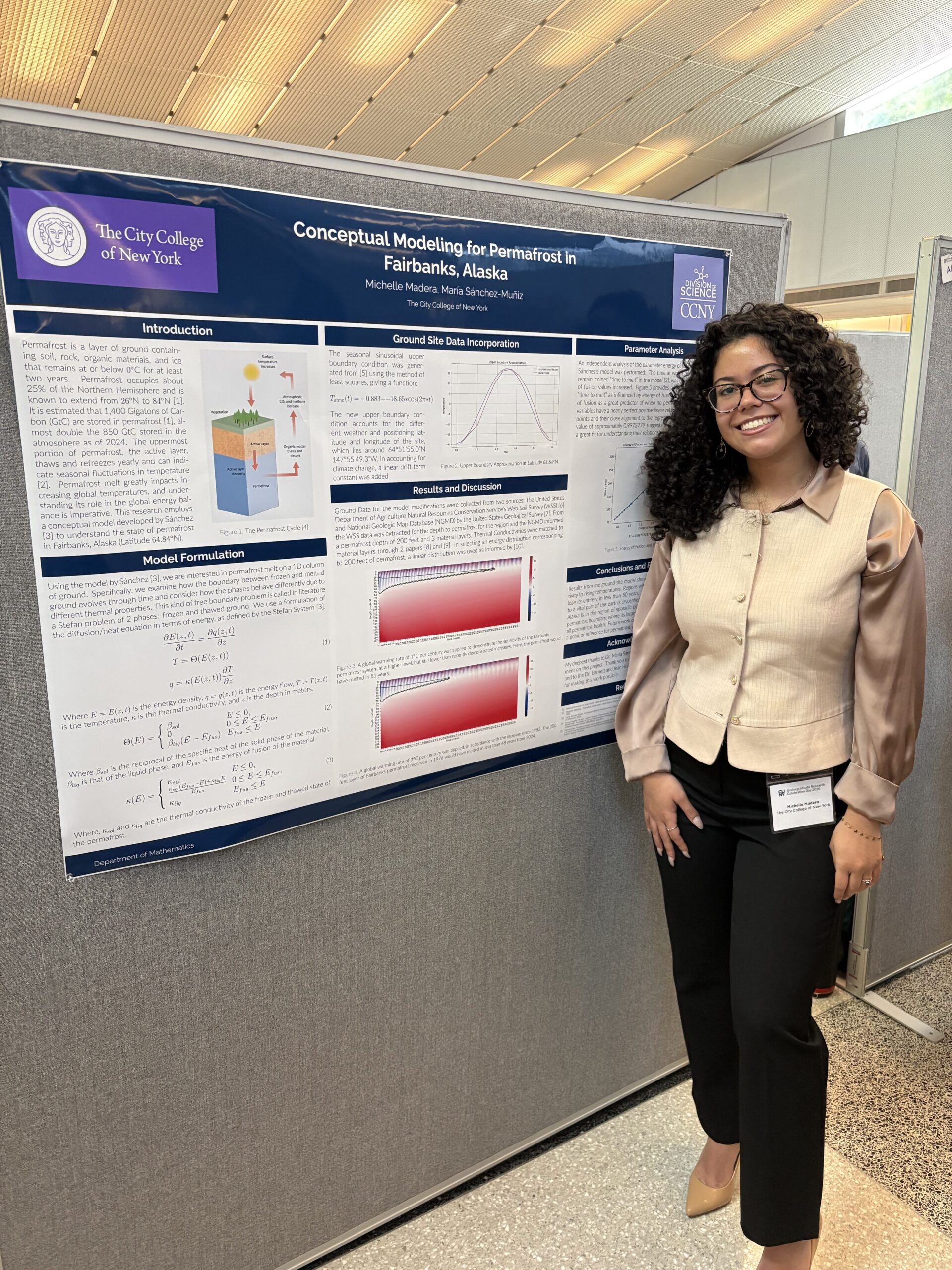
For Michelle Madera, mathematics has always been her favorite language for understanding the world. At CCNY, her passion for mathematics has evolved into a commitment to applying her knowledge to address climate change, which is one of the most pressing challenges of our time.
A double major in Applied Mathematics and Italian, Madera presented her project, “Conceptual Modeling for Permafrost in Fairbanks, Alaska,” at CCNY’s Undergraduate Research Day, where she was awarded Best Poster Presentation.
Her research was conducted through the Rich Summer Research Internship offered by the Department of Mathematics. The project combined advanced mathematical modeling, computational methods, and climate science to investigate how rising global temperatures may affect permafrost stability in Fairbanks, Alaska.
Madera’s path to research has been shaped by both persistence and curiosity. Following her early interest in mathematics, she discovered a particular affinity for applied mathematics while taking an applied calculus course in high school. After graduating from high school during the COVID-19 pandemic and initially attending Dartmouth College, she stepped away from higher education for nearly a year and a half before enrolling at CCNY in Fall 2022.
At CCNY, her interest in applied mathematics led her to a Research Experiences for Undergraduates (REU) program in Florida during the summer of 2023, funded by the U.S. National Science Foundation, where she quantified glacial recession using satellite imagery. The experience introduced her to the possibilities of applying mathematical methods to environmental questions and ultimately set her on the path toward climate research.
“I always enjoyed the application part of math,” Madera said. “I really like the idea of using math for a greater purpose.”
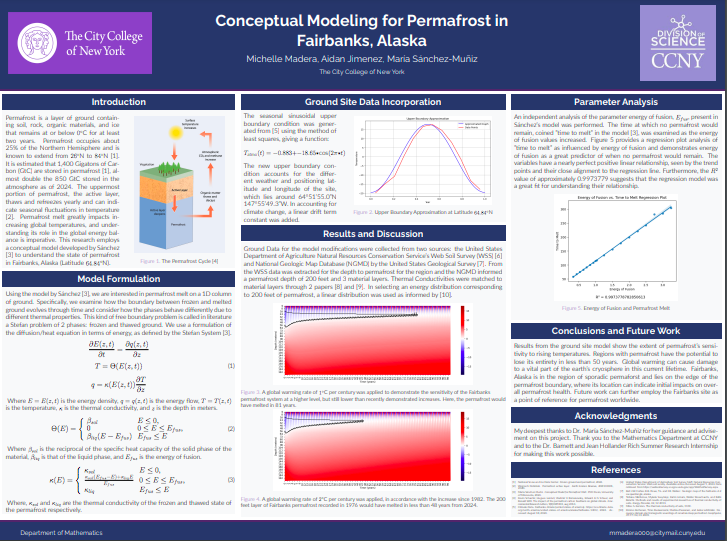
Research Poster presented at the event. Photo Credit: Courtesy of Michelle Madera.
For her Undergraduate Research Day project, Madera investigated permafrost, which is ground that has remained frozen for at least two consecutive years and is found primarily in Arctic regions. Permafrost stores enormous amounts of organic carbon accumulated over thousands of years. As global temperatures rise and permafrost thaws, the stored carbon is released into the atmosphere as greenhouse gases, intensifying warming and creating a feedback loop that accelerates further melting.
“Permafrost actually holds approximately 1,400 gigatons of carbon,” Madera added, noting that this is nearly double the amount of carbon currently present in the atmosphere. “That’s why permafrost is an extremely important part of the cryosphere to study.”
The project is based on a conceptual model originally developed by her mentor and lecturer in the Department of Mathematics at CCNY, Dr. María Sánchez-Muñiz, during her doctoral research. The model treats permafrost as a one-dimensional column of ground and uses an energy-based Stefan-type phase-change framework to simulate the evolution of frozen and thawed layers over time.
Madera used soil composition data from the U.S. Department of Agriculture’s Web Soil Survey and information from the National Geologic Map Database to incorporate site-specific data from Fairbanks, Alaska, which is a region near the permafrost boundary, into the model. She then analyzed how varying warming scenarios could affect the long-term persistence of permafrost.
Her simulations revealed that under a warming rate of 1 degree Celsius, permafrost at the study site could disappear in approximately 81 years. Under a warming rate of 2 degrees Celsius, a scenario more closely aligned with current climate projections, complete loss could occur in about 48 years.
Dr. Sánchez-Muñiz described Madera as a researcher with “intellectual maturity, persistence, and willingness to engage with challenging mathematics.” She also noted Madera’s ability to move fluidly between mathematics, computation, and climate interpretation, as well as her initiative in extending the project in new theoretical directions.
“As Michelle’s mentor, my role has been to help her develop and refine a mathematical research project, from the initial modeling questions to a clear scientific narrative,” Dr. Sánchez-Muñiz said. “In our meetings, I helped Michelle connect the mathematical structure of the model to the climate-science questions, interpret simulations, refine her parameter analysis, and communicate her results to a broader audience.”
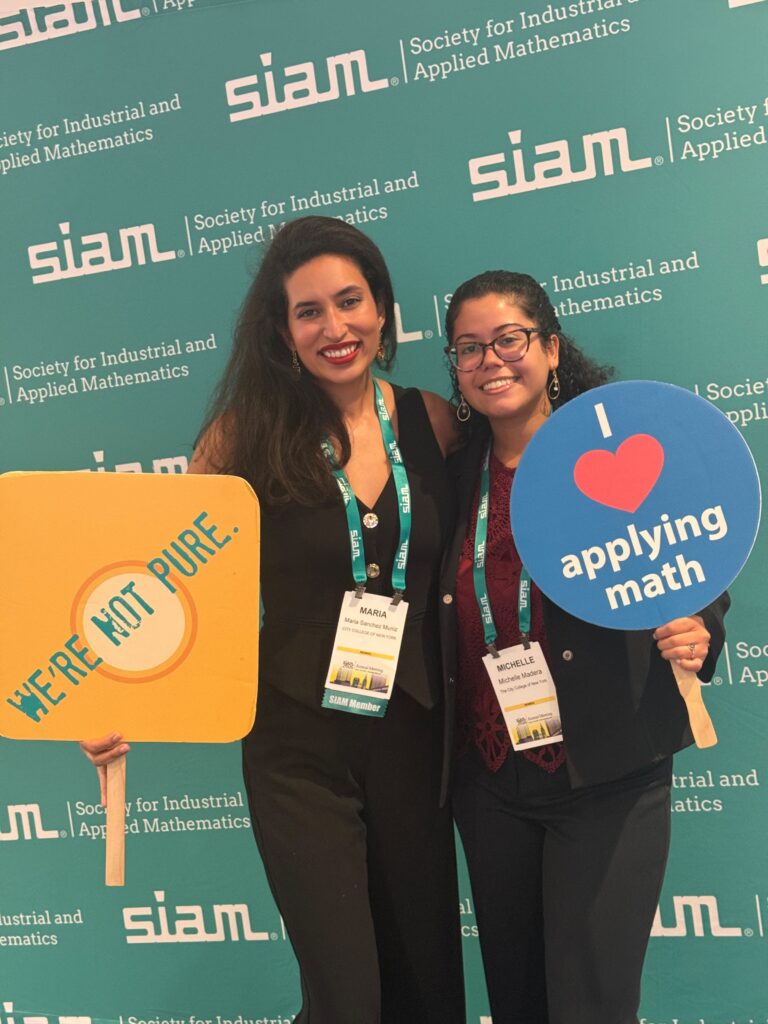
Michelle and her mentor Dr. Sanchez-Muñiz attending the SIAM Annual Conference. Photo Credit: Courtesy of Dr. Sanchez-Muñiz.
The project was also shaped by undergraduate collaboration. CCNY undergraduate student Aidan Jimenez, an applied physics and pure mathematics major and student researcher under the mentorship of Professor Gabriele Grosso at CUNY’s Advanced Science Research Center, worked alongside Madera on the project, contributing computational analyses and helping investigate limitations within the simulation framework.
Jimenez worked on characterizing instances in which the partial differential equation solver became unstable during long simulations. Instead of implementing an entirely new numerical method, the team explored alternative computational approaches, including extending simulation times to better understand the model’s behavior.
He explained that the collaboration became very formative for him in his academic journey.
“‘Conceptual Modeling for Permafrost in Fairbanks, Alaska’ was my first research project and helped lead me down the path of research that I do today,” he said.
For both students, the project demonstrated the collaborative nature of scientific inquiry.
“I have worked on things I never imagined I would be able to work with, and met people that I am glad to work with. Especially because research is a very social thing. You depend on and work with mentors, collaborators, and those around you to motivate and bounce ideas with,” Jimenez reflected. “This project had a lot of collaboration, and I cannot think of a better introduction to research than the experience I had here.”
That spirit of collaboration is precisely what Madera also said made her mentorship experience so transformative.
“Her mentorship has been one of the most important aspects of my undergraduate career,” Madera said of Dr. Sánchez-Muñiz.
Following a previous research experience that left her uncertain about pursuing a career in academia, Madera said that working with Dr. Sánchez-Muñiz fundamentally changed her perspective.
“I was able to see that mentorship and guidance can be this really beautiful relationship,” Madera explained. “It showed me that the best mentors do more than teach technical skills. They enhance curiosity, strengthen your intellectual independence, and help you build the confidence to explore difficult questions whose answers are not yet known.”
For Madera, the Undergraduate Research Day event provided an opportunity not only to share her findings but also to engage with fellow researchers across disciplines and gain experience communicating complex scientific ideas to a broad audience.
In addition, Dr. Sánchez-Muñiz believes presenting at the event gives students the opportunity to see themselves as emerging scholars contributing to a larger research community.
“These op portunities are essential because they help students develop communication skills, gain professional visibility, and feel a stronger sense of belonging in academic spaces,” Dr. Sánchez-Muñiz said. “Michelle did an amazing job, and I was especially proud that she won the Best Poster Award. It has been a pleasure to mentor her and watch her grow through this process.”
As Madera prepares to apply to doctoral programs ranging in fields such as computational science, engineering, or applied mathematics, she hopes to continue conducting climate research while remaining committed to public engagement and science communication.
“I really hope that my research can broaden people’s perspectives,” Madera said. “I hope that people who maybe don’t have the background or the tools to understand the technical aspects of the research can still understand its impact.”

Sofia is a graduate student at CUNY Brooklyn College, where she’s pursuing her M.S. in Media Studies. Her work centers on cultural affairs, capturing people’s lived experiences, and producing work that is not only compelling and polished but also intentional, inclusive, and aligned with meaningful public impact. In addition to writing for The RICC, she’s a dedicated writer for the Brooklyn News Service.