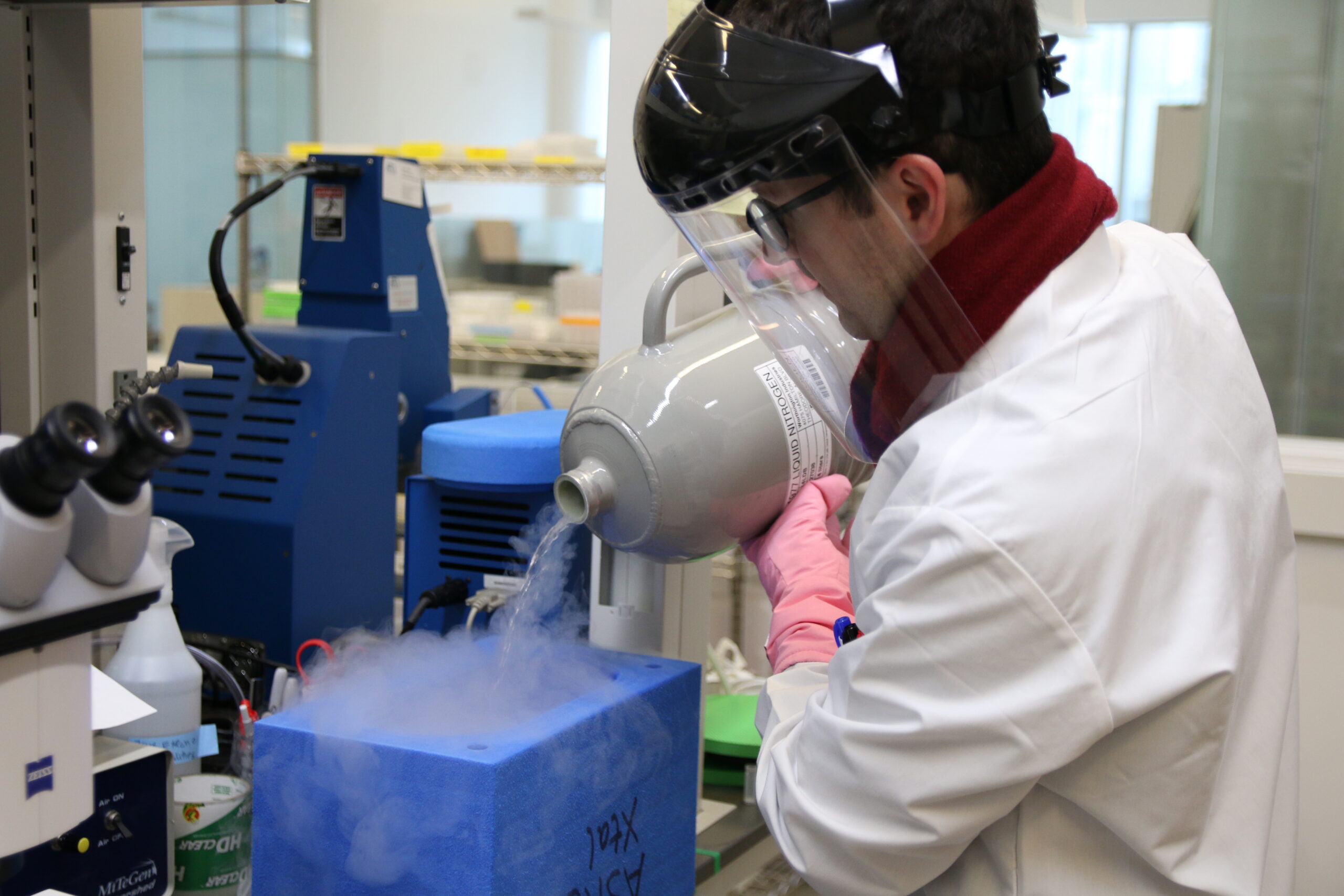
Daniel A. Keedy has many reasons to celebrate. The Associate Professor in CCNY’s Department of Chemistry and Biochemistry is a recent recipient of the National Science Foundation’s Faculty Early Career Development (NSF CAREER) Award. As an awardee, Keedy has been granted $948,848 to fund research at the Keedy Lab, located at the CUNY Advanced Science Research Center within the Structural Biology Initiative.
The NSF CAREER Award acknowledges early-career faculty that are at the forefront of innovative research and leadership by providing funding to support further breakthroughs in science, engineering, technology, and education.
At the Keedy Lab, Keedy and his team of researchers are looking to develop methods of exploring the behaviors and structures of proteins to examine how their shapes contribute to their specific biological processes. In doing so, he works to better understand how to alter, or manipulate, designed protein molecules for therapeutic intervention or protein engineering, with the help of tools like artificial intelligence.
“Natural enzymes are these marvels of nature, little nanomachines that catalyze chemical reactions super well, while designed enzymes aren’t as efficient,” said Keedy. “We’re trying to figure out what might be missing in current approaches.”
Keedy has had a longtime interest in how things work at the molecular level, which has largely shaped the path he has taken in his career. Having completed his PhD at Duke University in Biochemistry and Structural Biology & Biophysics, and unsure of what his next move would be, he continued into postdoctoral research at the University of California San Francisco (UCSF) where he studied computational modeling and experimental characterization of functional protein flexibility. From there, Keedy explored opportunities in biotech before determining he found himself more drawn to faculty positions. There, he could control the questions he wanted to answer and explore, while having the opportunity to mentor students in the lab as they conduct their own research. “I wanted to pay it forward; that’s what drew me to creating the lab,” said Keedy.
The lab is currently examining the role of adaptability in enzyme designs. Building on their understanding of the inherently fluctuating dynamics of enzymes, Keedy and the student researchers are trying to unlock better designed enzymes by controlling their flexibility. “Typically, people have designed enzymes as a rigid, static structure, but we know that enzymes need to move and fluctuate. So, we’re inputting multiple structural states and finding a sequence that can allow the protein that we make to convert between each of these states instead of just one.”
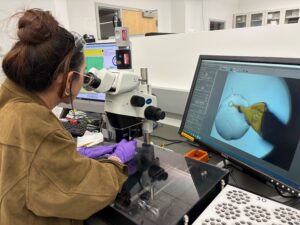
“We’re now gearing up to have students in my undergraduate biochemistry course design their own proteins using these very easy-to-use, modern AI tools, so they get some exposure and they get to consider the types of research going on in biochemistry and structural biology labs,” said Keedy. “We hope that they use these tools and come up with ideas that we might not have thought of, so we can test them in the lab and get some interesting research results.”
Reflecting on his time as an undergraduate student studying Biochemistry & Molecular Biology at Rhodes College, Keedy compared his experience designing protein structures versus modern computational abilities as “night and day.” He elaborated that it’s now possible to redesign an entire protein model of three hundred amino acids in seconds, whereas the algorithms he had access to could only redesign about ten of those three hundred amino acids, and would take hours, even days, to compute. “It’s just much more efficient and accessible,” emphasized Keedy.
With the NSF CAREER award, Keedy is looking forward to continuing to bridge the research world with the classroom. He plans to create roles for PhD and postdoctoral students to work in the lab, as well as fund opportunities for undergraduate students who have done previous coursework with Keedy to directly test the proteins designed by students currently in his course.
“I hope that with this integrated cycle, students from the class join the lab and are able to do research,” said Keedy. “They’ll remain connected and can get a stipend as well.”
He is also looking to expand the kinds of research the lab can conduct.
“We have a lot of data about these static protein structures, but not so much about protein dynamics or movement,” said Keedy. “I’m interested in how we can move the field forward with bigger collaborative consortiums and the involvement of different researchers to build the next generation of data that will make these protein AI models better and better.”

Natalie Elysse Moreno is an interdisciplinary artist working to develop journalistic work through a creative lens. Natalie is an undergraduate student at The City College of New York, pursuing a double major degree in Journalism and Latin American Studies with a minor in English. While at CCNY, she has found her voice through storytelling, primarily enjoying writing articles centered on community and sustainability as well as creative essays about her life experiences. She’s worked with Harlem View, the HIPE Network, BronxNet, WHCR 90.3 Fm, and CUNYTV.