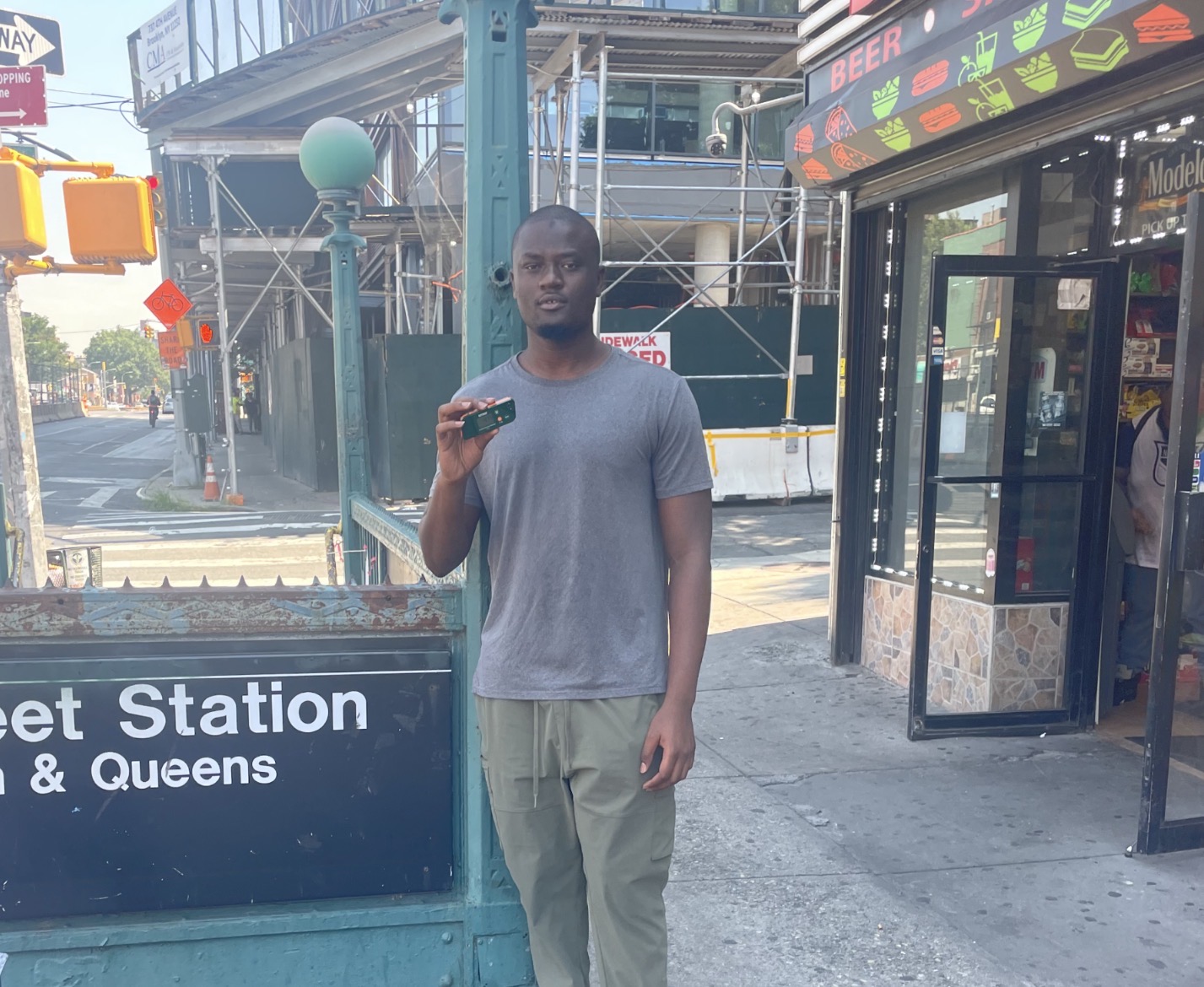
From Kingston-Throop Ave to High St, mechanical engineering student, Babacar Sarr, has spent months compiling data on the heat and air pollution in MTA train stations along the C line.
In collaboration with the MTA’s Climate Resilience division, Sarr and a team of six other interns used portable sensors to gather and assess temperature data across these different Brooklyn stations, while other groups measured train lines and stations across other boroughs. By comparing indoor and outdoor temperatures, they were able to determine how underground stations retain heat as well as other particles. “I was doing research in several stations at Brooklyn and two stations High st and Hoyt-Schermerhorn present, for example, high risk of carbon dioxide emissions because there’s construction and many people,” he said.
“The main goal of the research was to evaluate the environmental parameters in Brooklyn’s subway station and to identify which station posed the high risk of health and presented the highest heat and worst air quality,” said Sarr. “We want to identify what stations present those health risks to people and potentially modify the air ventilation or make adjustments for those for the stations.”
Sarr’s team identified these stations by measuring PM2.5 and PM10, temperature, relative humidity and carbon dioxide. In doing so, they identified poorly ventilated stations and the need for targeted cooling, ventilation improvements, and climate-resilience upgrades for improvements in rider comfort and safety during peak seasonal climates.
“We were able to collect data in the summer, the fall and spring; during different seasons and different times of day,” said Sarr. “If you look at the data in the fall and spring, you’d think that’s summertime because of the high temperature and humidity in those stations.”
Sarr first became involved with this project after completing his software AutoCAD classes at BMCC, and finding the National Science Foundation (NSF) opportunity. Shortly after, he became an IUSE participant and a REU scholar working on heat and health quality monitoring under his mentors Dr. Reginald Blake, Dr. Hamid Norouzi, and Dr. Abdou Bah. “The REU is really something that is going to open doors for you,” emphasized Sarr. “We had the chance to travel. Our Brooklyn team traveled to Houston and did a presentation at the American Meteorology Society annual conference.”
Following his work during these research opportunities, not only is Sarr looking forward to his final semester at City College, he is also beginning work at Salas O’Brien as a Clean Energy intern. There he will be working alongside Con Edison to build energy models for buildings in Astoria, Queens and for NYU’s dormitories, calculating how much cooling and heating needed throughout the year.
“I remember doing my interview with Salas O’Brien; they were interested about the research I did with the NSF in the REU,” said Sarr, adding, “They were really interested about the project.”
“I advise students to go to any research they can. Anything they’re interested in, go with it because there’s two worlds: the school world and the experience world. When you get to the real world, you’re going to learn new things, things they never teach you in engineering school,” said Sarr. “If you can manage both your schoolwork and gaining experience, in research or industry, whatever you can get your hands on, I think it’s better to do that.”